Unsupervised Visual Exposure Builds Generalizable Population Geometry in Mouse Visual Cortex
Abstract
Unsupervised visual exposure drives neural plasticity in sensory cortex and accelerates subsequent supervised learning (Zhong et al., 2025), but the underlying mechanism remains unclear. Here we re-analyze their publicly available dataset using population geometry methods, specifically normalized population distance and coding axis alignment, to compare representation changes in supervised (n=1) and unsupervised (n=1) mice across three phases: before learning, after learning, and generalization to novel stimuli (test1). We find that both groups increase stimulus discriminability after learning, but unsupervised representations are more stable across contexts (100% vs 75% retention) and maintain a highly aligned coding axis when generalizing to novel stimuli (cosine similarity: 0.685 vs 0.131). These preliminary results suggest that unsupervised pretraining accelerates learning not by producing stronger discrimination, but by establishing a direction-stable, reward-independent coding axis that transfers across stimulus exemplars.
Setup
Zhong et al. recorded ~60,000–80,000 neurons simultaneously from V1 and higher visual areas (HVAs) in mice navigating virtual corridors with two visual textures: circle and leaf patterns. One group of mice (supervised) received water rewards in circle corridors; another group (unsupervised) received no rewards but was exposed to the same stimuli.
We focused on two mice with available neural data:
- VR2 (supervised): 348 trials before learning, 470 after
- TX105 (unsupervised): 201 trials before, 259 after
Both mice also had a test1 session with novel stimuli (circle2, leaf2) that were similar but not identical to the trained textures.
Neural activity was provided as SVD-decomposed data (400 components × time frames). For each trial, we averaged the population activity vector during the textured corridor segment, yielding a 400-dimensional representation per trial.
Analysis 1: Normalized Population Distance
We computed the Euclidean distance between the centroids of circle and leaf trial vectors, normalized by the average trial vector norm (to account for different SVD scales across sessions).
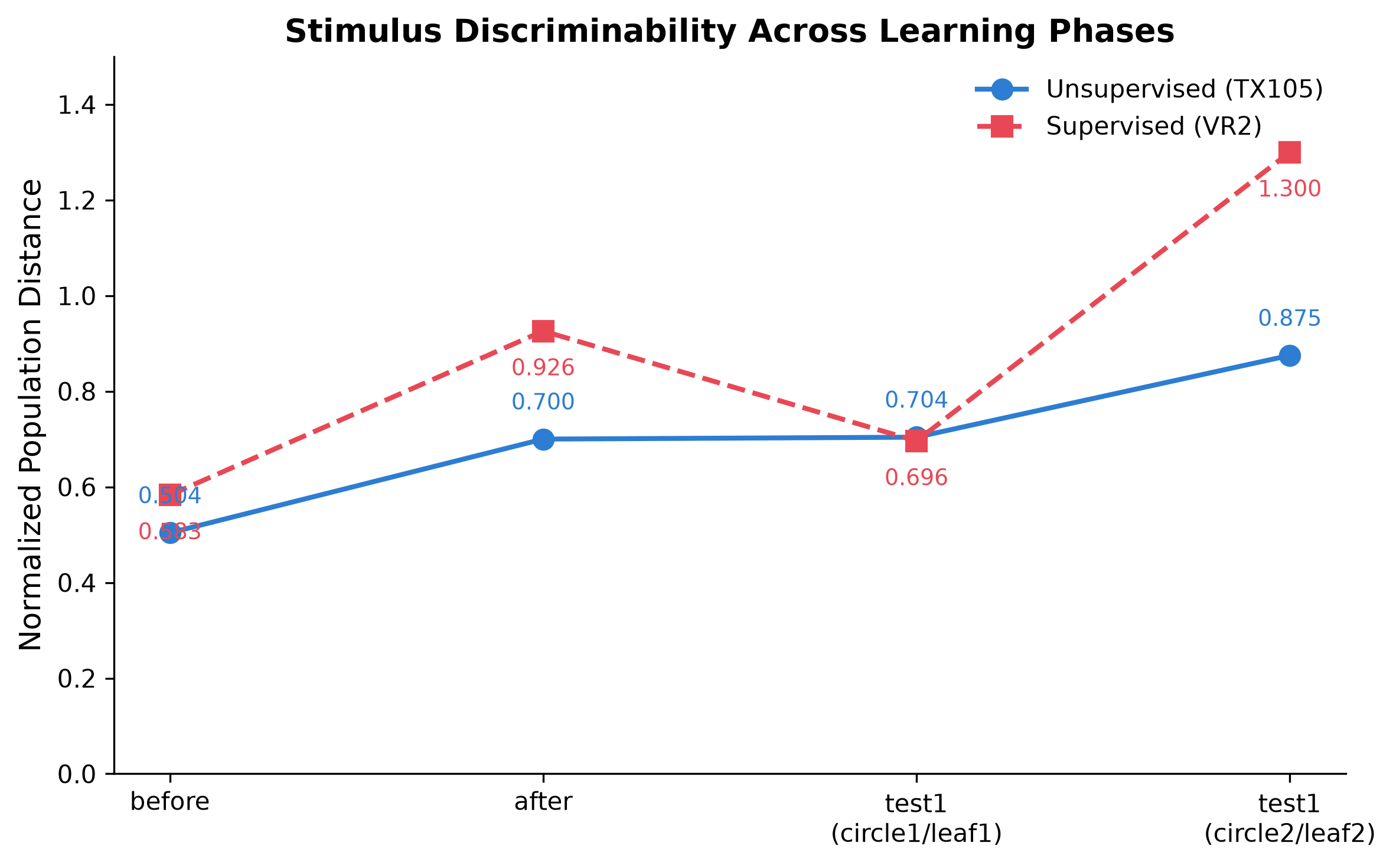
| Condition | Before | After | Test1 (circle1/leaf1) | Test1 (circle2/leaf2) |
|---|---|---|---|---|
| Unsupervised | 0.504 | 0.700 | 0.704 | 0.875 |
| Supervised | 0.583 | 0.926 | 0.696 | 1.300 |
 |
Three observations:
Both groups increased discriminability after learning. Unsupervised exposure alone — without any reward — pushed circle and leaf representations apart (0.504 → 0.700, +39%). Supervised learning pushed them further (0.583 → 0.926, +59%).
Unsupervised representations are more stable. When tested with the same old stimuli (circle1/leaf1) in the test1 session, the unsupervised distance barely changed (0.700 → 0.704, retention: 100.6%), while the supervised distance dropped 25% (0.926 → 0.696). This suggests that part of the supervised representation is bound to the reward context and degrades when that context changes.
Supervised shows higher absolute discriminability for novel stimuli, but this alone does not mean better generalization — which leads to the next analysis.
Analysis 2: Coding Axis Alignment
Raw distance can be misleading. Two representations can both show large distances, but if they use orthogonal axes to discriminate, one cannot generalize from the other. We computed the cosine similarity between the discrimination axis learned in the after session (circle1 vs leaf1 centroid difference) and the axis used in test1 for novel stimuli (circle2 vs leaf2).
| Condition | Coding Axis Alignment |
|---|---|
| Unsupervised | 0.685 |
| Supervised | 0.131 |
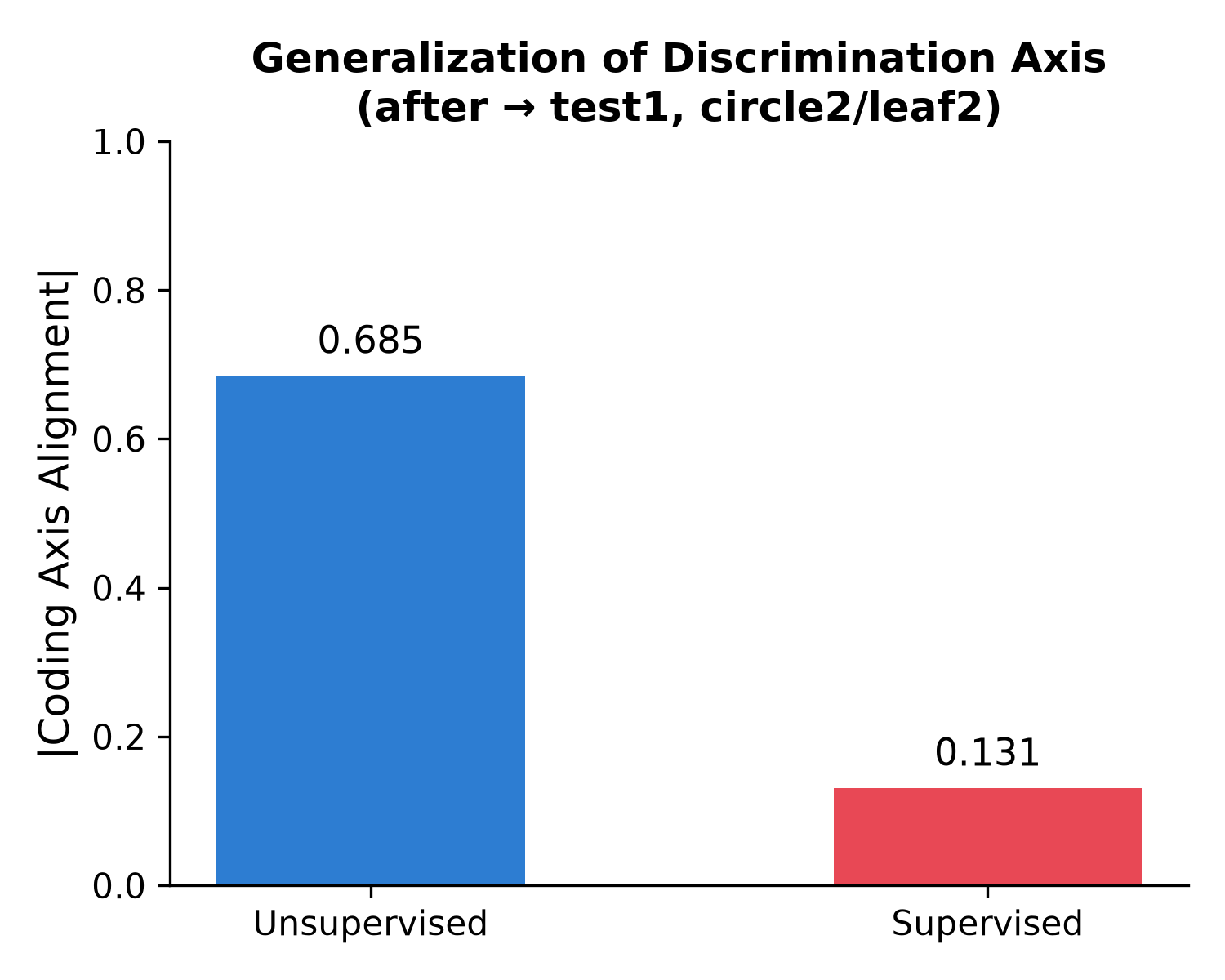
This is the key result. The unsupervised mouse discriminates novel stimuli using nearly the same axis it learned during training — the cosine similarity of 0.685 indicates a highly preserved coding direction. The supervised mouse, despite achieving a larger absolute distance on novel stimuli (1.300), uses an almost entirely different axis (0.131, near-orthogonal).
Interpretation
These results suggest a specific mechanism for how unsupervised pretraining accelerates supervised learning:
Unsupervised exposure builds a direction-stable, reward-independent coding axis. This axis captures abstract category features (circular vs leaf-like textures) rather than low-level pixel details, which is why it transfers to novel exemplars. The stability of this axis — both in distance retention and directional alignment — means it serves as a robust scaffold.
Supervised learning, by contrast, builds a reward-bound axis that achieves higher peak discriminability but is tied to the specific training context. When the context changes (test1), this axis largely collapses, and the brain switches to a different direction.
The acceleration mechanism is therefore not that unsupervised pretraining produces stronger discrimination, but that it produces more generalizable discrimination. Subsequent supervised learning can build on this stable foundation — adding reward signals and decision boundaries — rather than constructing representations from scratch.
Supplementary: Participation Ratio
We also computed the Participation Ratio (PR) of trial-by-trial population activity to test whether learning compresses representations into fewer effective dimensions.
| Condition | Before | After |
|---|---|---|
| Unsupervised | 10.6 | 18.6 |
| Supervised | 8.9 | 11.5 |
Contrary to the "manifold compression" hypothesis, PR increased after learning in both groups. Learning does not simply compress representations into fewer dimensions — it recruits more dimensions, making the encoding more distributed. This is compatible with increased mixed selectivity across the neural population.
Limitations
- n = 1 per group. All conclusions are preliminary observations from one supervised and one unsupervised mouse. No statistical testing is possible.
- Independent SVD spaces. Each session's SVD was computed independently, so cross-session distance comparisons rely on normalization assumptions.
- Missing baseline for novel stimuli. There is no before-learning recording with circle2/leaf2, so we cannot fully rule out that the novel stimuli are inherently more discriminable than the trained ones.
- Coding axis alignment across SVD spaces. The alignment metric compares axes from the after and test1 sessions, which occupy different SVD coordinate systems. The comparison is valid to the extent that SVD captures similar variance structure across sessions from the same mouse, but this assumption should be noted.
References
Zhong, L., Baptista, S., Gattoni, R., Arnold, J., Flickinger, D., Stringer, C., & Pachitariu, M. (2025). Unsupervised pretraining in biological neural networks. Nature, 644, 741–748.
Data: Janelia Figshare. Code: available on request.


